

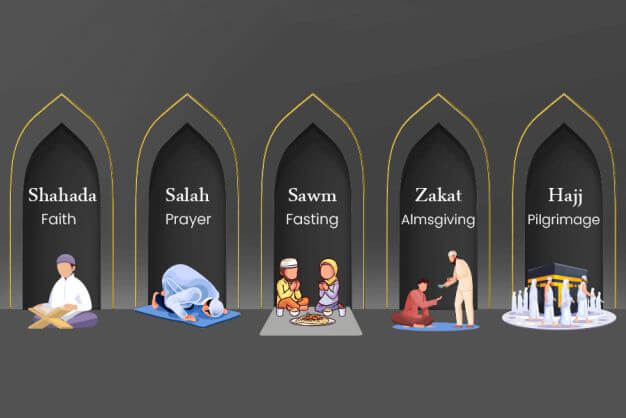
Imagine you just met someone who said, “Tell me briefly what Islam is about.” You might point to the Five Pillars of Islam as a shorthand. These five acts offer a framework, a daily rhythm, and a lifelong journey. In this article, I’m going to explain each of the Five Pillars of Islam in a way a beginner can grasp—without assuming you already know Arabic or theological jargon.
By the end, you’ll have a clear understanding of:
- what each pillar means,
- how Muslims practice them,
- common questions or exceptions,
- and how these pillars shape Muslim life in real, everyday terms.
I’ll also share personal reflections and examples that bring these principles to life. (Yes, I’ve walked parts of this road myself.) Let’s get started.
What Are the Five Pillars of Islam?
Before we dive into each, let’s name them and see how they fit together. The Five Pillars of Islam are:
- Shahada – the declaration of faith
- Salah (also spelled Salat) – the ritual prayer
- Zakat – giving alms or charity
- Sawm – fasting during Ramadan
- Hajj – pilgrimage to Mecca
These pillars form a foundation for Muslim life. As one Islamic scholar put it, Islam can be imagined as a building supported by five pillars—without any one, the structure weakens.
One more thing to note: while these pillars are uniquely Islamic, in practice they shape one’s internal life, community life, and relationship with God. Many Muslims describe them not as burdens, but as channels.
Now let’s look at each in turn.
Shahada: The Declaration of Faith
Meaning & Formula
The word Shahada literally means “witnessing” or “testimony.” It consists of the phrase (in Arabic):
La ilaha illa Allah, Muhammadun rasul Allah,
which translates to: “There is no god but Allah, and Muhammad is the Messenger of Allah.”
Reciting the Shahada with sincerity—believing it in your heart—is the condition for becoming a Muslim.
Why It Matters
This pillar roots everything else in belief. It states monotheism (that God is singular) and anchors the prophethood of Muhammad. Without accepting this, the other acts (prayer, charity, etc) lose their spiritual foundation in Islam.
One way to see it is that Shahada is the “why,” while the other pillars are partly the “how.” If you think of a traveler, Shahada is the decision to begin the journey; Salah, Zakat, Sawm, and Hajj are steps along that journey.
Common Questions & Exceptions
- Some Muslims add extra phrases (for instance, Shia traditions sometimes include statements about Ali), but the core “no god but Allah; Muhammad is Messenger” is universal.
- Saying it once sincerely is enough to become a Muslim.
- It must be believed and understood in one’s heart, not just mouthed.
Personal Insight
I remember a friend who embraced Islam as an adult. His first act was uttering the Shahada before witnesses. He described it like opening a door—he felt both relief and awe, as though he had finally given voice to something that had felt true for a long time.
Salah (Prayer): Five Times a Day
What It Is
Salah (or Salat) means ritual prayer. Every Muslim who is able is required to perform five daily prayers at specific times.
The five prayer times are:
- Fajr – before dawn
- Zuhr – after midday
- Asr – mid-afternoon
- Maghrib – just after sunset
- Isha – night prayer
These times shift depending on your location and season.
How It’s Done
Before prayer, one must perform wudu (ritual purification, washing parts of the body). Then the prayer involves a sequence of standing, bowing, prostrating, and sitting, reciting verses from the Quran and praising God.
You can pray in a mosque or alone, as long as the place is clean and you face the direction of the Kaaba in Mecca.
On Fridays, there is a special congregational prayer (Jumu’ah) in many communities where a sermon is delivered.
Spiritual & Social Significance
Prayer punctuates the day. It reminds one that life is not only about work, rest, or pleasure, but a regular connection with God. It builds self-discipline and awareness.
In a community, congregational prayers strengthen bonds. Muslims gather, kneel, and recite together—in that moment, differences of status, wealth, or ethnicity recede.
Challenges & Adaptations
- In busy jobs or irregular shift schedules, planning becomes vital. Many devout Muslims carry prayer mats or use mobile apps to know prayer times.
- If someone is sick, traveling, or physically unable, exceptions or modifications exist.
- In places without mosques nearby, one may pray alone.
Example
I once traveled in a remote area where the only shelter was a small guesthouse. At midday, I laid my travel prayer mat on the floor, faced the right direction using a compass app, and completed the Zuhr prayer. It felt grounding. In that quiet moment, what mattered in life seemed very simple.
Zakat: Charity and Social Justice
Meaning & Purpose
Zakat means purification and growth. Giving a portion of one’s wealth back to the community helps purify the giver’s wealth and supports social justice.
It is a mandatory alms-giving (not a voluntary donation) for Muslims who reach a certain threshold of wealth (nisab).
Typically, 2.5% of eligible savings or assets that have been held for at least one lunar year are given.
Who Receives Zakat
In classical Islamic teaching, Zakat is distributed to specified categories: the poor, orphans, those in debt, travelers in need, and so on.
The goal is both to reduce inequality and to strengthen the bonds of community.
Practical Considerations
- Not all wealth is subject: personal items, basic necessities, and some assets may be exempt.
- In modern times, many Muslims calculate Zakat via banks, NGOs, or mosques that handle collection and distribution.
- Some combine Zakat (obligatory) with Sadaqah (voluntary charity) when helping beyond the minimum.
Impact in Real Life
I remember in one city, Zakat funds helped repair a local school’s roof. Children who might have studied in leaking classrooms could then learn in safer rooms. For many, Zakat is not just a ritual but a concrete tool for change.
Sawm: Fasting During Ramadan
What Sawm Means
Sawm is the fast that Muslims observe during the month of Ramadan, the ninth month of the Islamic lunar calendar.
From dawn until sunset, Muslims abstain from eating, drinking, sexual activity, and other invalidating acts. After sunset, they may break the fast.
The fast is not just physical—it’s spiritual. It’s a time to grow in patience, empathy for the poor, and focus on one’s inner life.
Rules & Exceptions
- Children, the elderly, travelers, pregnant or nursing women, the sick, or menstruating women may be exempt or make up missed fasts later.
- Intent (the niyyah) matters — a person should intend to fast for the sake of God.
- Some will also engage in extra prayer (Taraweeh) at night, read the Quran, and give more charity.
Meaning Beyond Hunger
By denying oneself food and drink for hours, a Muslim becomes more aware of dependence on God and also more empathetic toward those who suffer hunger daily. Many people say fasting helps reset their life habits: better eating, better priorities, checking how they speak, behave, and relate to others.
Personal Reflection
I once did a partial fast while traveling in a country during Ramadan. The timing was tricky, but by midday, I realized how much of life is shaped by food, routine, and distraction. During that fast, I kept pausing to reflect: Is my appetite for things—food, recognition, comfort—getting in the way of deeper purpose?
Hajj: Pilgrimage to Mecca
What Hajj Entails
Hajj is the pilgrimage Muslims are required to perform once in their life if they are physically and financially able.
It takes place during the Islamic month of Dhu al-Hijjah. Pilgrims wear simple white garments (called ihram) that strip away distinctions of wealth or status.
Key rituals include circling the Kaaba (seven times), walking between the hills of Safa and Marwah, standing in Arafat, and more.
Spiritual Significance
Hajj is meant to symbolize unity, humility, submission, and equality. Every pilgrim—rich or poor—does the same rituals in the same garments. It’s a powerful reminder that all are equal before God.
Many call Hajj a culmination of a Muslim’s devotion. It is deeply emotional: repentance, prayer, awe, connection to history, and connection to the broader Muslim community.
Logistics & Challenges
- Planning is complex: travel, visa, accommodations, and physical demands.
- Hajj is crowded and intense, often involving long walks, uncomfortable heat, and logistical hurdles.
- Many people save for years to make it possible.
Example
I spoke with someone who performed Hajj in her late fifties. She said the moment she first saw the Kaaba was overwhelming—a flood of gratitude, humility, tears. She told me, “I felt as though I was standing with every generation of believers behind me.”
Common Misconceptions & Tips for Beginners
- Not all Muslims follow perfectly
Observance varies. Some may miss a prayer, skip fasting, or delay Hajj. Circumstances like health, work, or family can affect practices. - Understanding vs mechanical performance
It’s not enough to perform rituals mechanically. Understanding the meaning deepens one’s connection. - Exceptions are built in
Islam recognizes human limitations—so exceptions (illness, travel, women in certain conditions) are part of its mercy. - Cultural practices vs pillars
Some practices commonly associated with Islam (dress styles, food customs, extra prayers) are cultural, not part of the Five Pillars. - Balance is key
The pillars aim to balance inward spirituality (faith, prayer, fasting) with outward responsibility (charity, pilgrimage).
How the Five Pillars Shape Muslim Life
- Daily Schedule: Prayer times structure the day—even in work or school, in many Muslim communities, people pause for prayer.
- Awareness of Others: Zakat reminds believers that wealth is not just personal—it belongs to a broader community.
- Self-Discipline: Fasting teaches restraint, focus, and breaks dependence on comfort.
- Community Bonds: Praying together, giving charity, sharing in Ramadan, gathering for Hajj—all these form social cohesion.
- Identity & Belonging: For many, the Five Pillars root them in a global community that spans continents and generations.
I have noticed that students who embrace these practices often talk about “inner peace” not as the absence of stress, but as confidence that their life has a center.
Conclusion
Understanding the Five Pillars of Islam gives you a window into how Muslim life is lived—and why it’s more than ritual: it’s a holistic commitment to faith, community, and purpose.
Comments are closed